
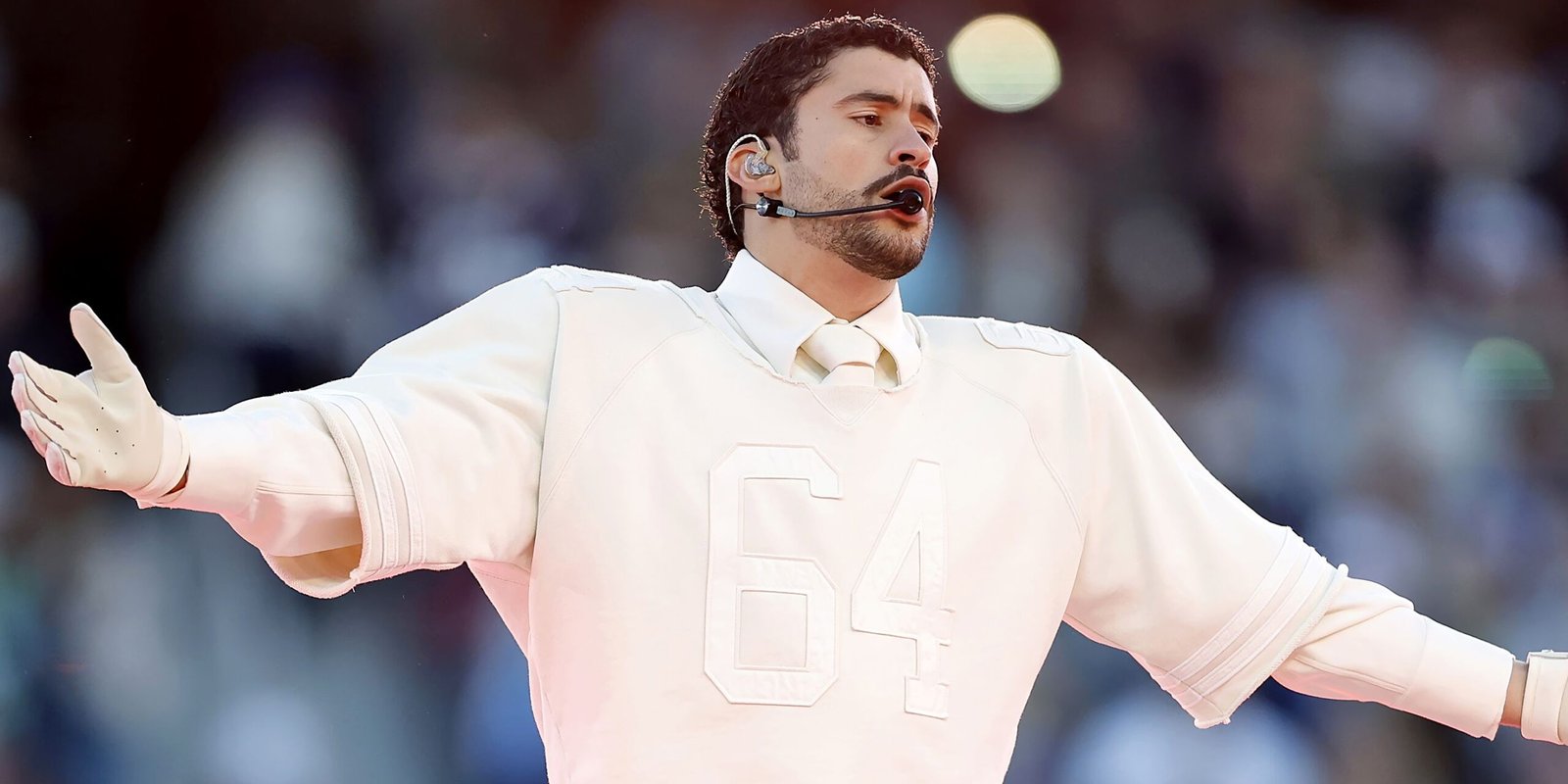
A Halftime Show That Rewrote the Playbook
Bad Bunny (Benito Antonio Martínez Ocasio) used a 13-minute Super Bowl LX halftime set to deliver one of the most culturally resonant performances in recent memory. Born in Bayamón, raised in Vega Baja and once working as a bagger at a local Econo supermarket, the 31-year-old took the NFL’s biggest stage and chose intimacy over spectacle. Rather than pack his slot with an overstuffed medley aimed at universal translation, he presented an unapologetically Puerto Rican narrative and trusted the audience to receive it.
The results were unmistakable: the show reportedly reached more than 135 million viewers and became a defining moment for representation on a platform that has traditionally prioritized pop maximalism.
Staging Puerto Rico: Details Over Gimmicks
Bad Bunny’s stage avoided the usual halftime tropes—mass pyrotechnics and dizzying screens—in favor of culturally specific imagery that conveyed place and history. The opening tableau of sugar cane fields set the tone. On the field, viewers saw:
- Jíbaros in straw hats playing dominoes
- Piragua vendors and a casita that functioned as both set piece and symbolic home
- A live wedding staged amid the performance, anchoring the show in everyday community rituals
This approach turned the stadium into a neighborhood block party and a living archive: a textured presentation of work, joy, resilience and wounds yet to heal. Celebrities including Karol G, Pedro Pascal, Jessica Alba and Cardi B blended into the audience rather than dominating it—an intentional choice that framed fame as community rather than spectacle.
Language, Music and Cultural Validation
Bad Bunny made history as the first solo Super Bowl halftime performer to deliver an entire set in Spanish. That linguistic choice mattered. Singing in Spanish at a moment watched by tens of millions was more than a musical preference; it was a claim to cultural visibility on a U.S. stage. The performance demonstrated that authenticity need not be softened for mass consumption—culture can speak powerfully in its own tongue.
Musically, the set threaded both mainstream and deeply local references. Visuals evoking Hurricane Maria—exploding power lines and blackout imagery—accompanied “El Apagón,” grounding the performance in recent, painful Puerto Rican experience. He paid tribute to the artists and traditions that shaped reggaetón and Puerto Rican music, invoking the lineage of performers who built those sounds long before they became global commodities.
Political Resonance—Without a Speech
Expectations before the show included speculation about explicit political messaging. Instead of delivering a manifesto or a direct call-out, Bad Bunny used symbolism and scene-making to communicate. He briefly addressed the crowd in English—saying “God bless America,” then listing countries across North, Central and South America while holding a football stamped “Together, We Are America,” which he emphatically spiked. The act read as an inclusive assertion: America can be continental and plural, not proprietary.
He avoided headline-grabbing confrontations. Rather than shouting slogans, he layered references—musical, visual and performative—that highlighted colonial histories, gentrification and infrastructural neglect without reducing them to soundbites. The closing moments—plena instruments, traditional dancers and the refrain seguimos aquí (“we’re still here”)—served as a quiet insistence on survival and presence.
High-Profile Moments and Guest Appearances
Bad Bunny’s set included a number of standout moments and collaborators that complemented his central narrative:
- Ricky Martin joined for “Lo Que Le Pasó a Hawaii,” a segment that referenced gentrification and modern-day colonial dynamics.
- Lady Gaga made a cameo during the on-field wedding, performing a salsa rendition of “Die With a Smile.” Her appearance—she wore a blue gown featuring a flowering plant symbolizing Puerto Rico—functioned as a contrast that underscored Bad Bunny’s global reach without eclipsing his story.
- The staged wedding, everyday vendors and community members on the field reinforced the show’s ethos of lived experience.
These choices emphasized community and cultural continuity over celebrity spectacle.
Reception, Backlash and What the Numbers Say
Reactions were polarized. Some conservative commentators and public figures labeled the performance provocative; former President Donald Trump called it a “slap in the face,” and critics from the right framed the halftime show as un-American before it aired. At the same time, the massive viewing figures and widespread social-media engagement suggested that millions embraced Bad Bunny’s version of America—one that includes Puerto Rico and other nations of the hemisphere without dilution.
The halftime moment also stood in direct contrast to an alternative, conservative “All-American Halftime Show” promoted by some groups. Bad Bunny’s set offered a different answer to the question of who gets to define American identity—less a shout of exclusion and more an expansive invitation.
Why This Performance Matters
Bad Bunny didn’t ask for permission to exist on that stage in his own language and with his own symbols. He simply occupied the space—with confidence, specificity and cultural pride. The show demonstrated several important shifts:
- Major, mainstream platforms can host deeply localized storytelling and still reach global audiences.
- Representation does not always require polemics; visual, musical and communal cues can convey powerful political truths.
- The definition of “America” remains contested, and cultural moments like this one illustrate how art can reshape that conversation without explicit speeches.
For many viewers—especially Puerto Ricans and Spanish speakers across the hemisphere—the halftime show was more than entertainment. It was validation: a brief but vivid reminder that culture, presented honestly and without translation, is itself an argument.
Closing: From Econo to the Biggest Stage
The arc from a young man bagging groceries in Vega Baja to a performer commanding the Super Bowl field is as much personal triumph as it is cultural significance. In just 13 minutes, Bad Bunny showed that presence can be protest, that joy can be resistance, and that an unapologetic celebration of home can speak louder than any prepared statement.