
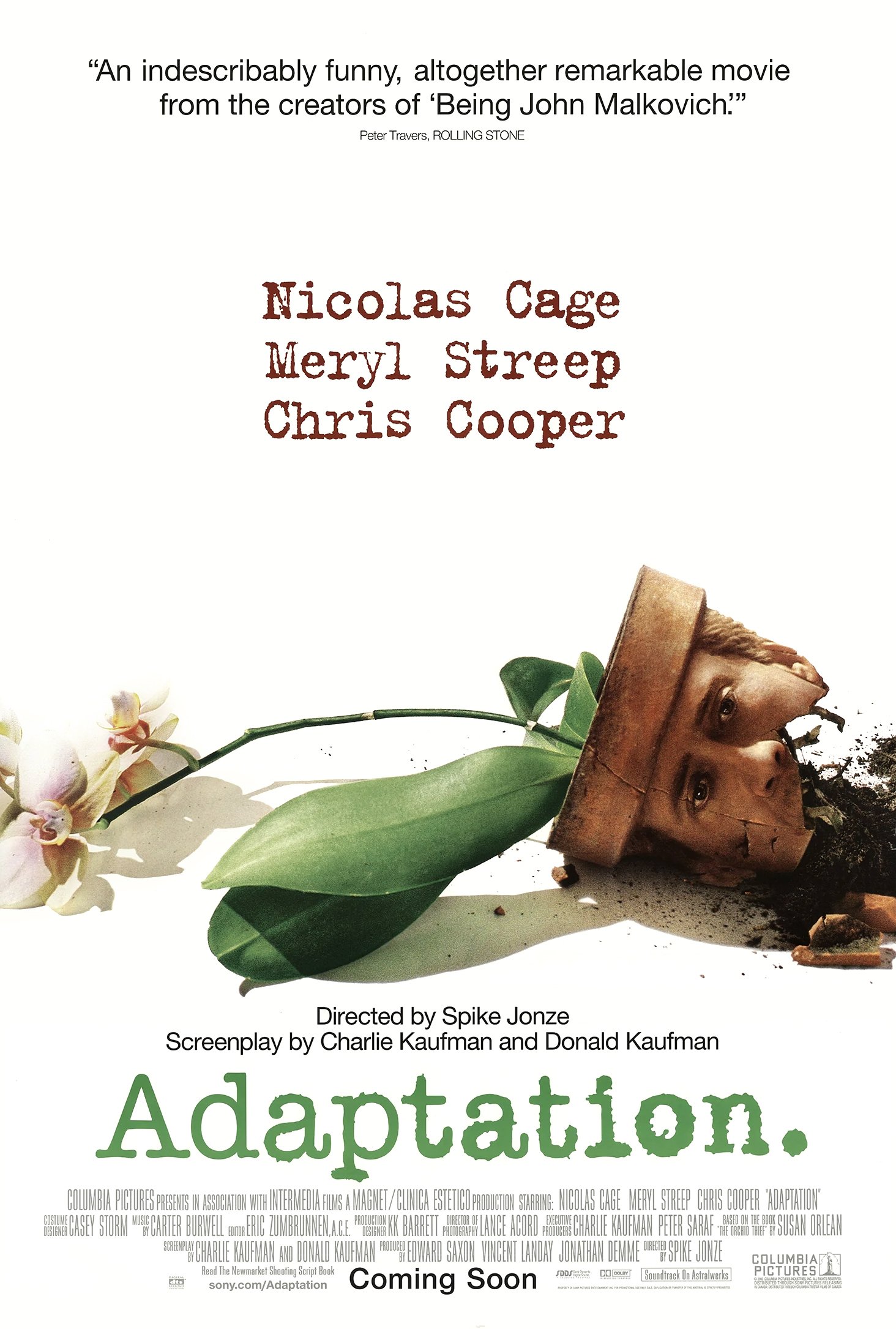
Information
tl;dr
Quick verdict
“Adaptation” masterfully blurs the lines between reality and fiction, crafting a meta-narrative that’s as introspective as it is entertaining. It navigates the challenges of translation from page to screen with a refreshing honesty, making it a provocative watch that’s as much about the process of creation as it is about the story itself.
One-line recommendation
A cerebral exploration of creativity and identity, “Adaptation” is a must-watch for anyone interested in the tangled art of storytelling.
Is the story engaging and does the pacing hold up?
How the unusual structure affects momentum
The film’s unconventional structure is its beating heart, oscillating between the world of the book and its cinematic adaptation. This dual narrative adds layers rather than diminishing the momentum; it invites viewers to dissect the nature of adaptation itself. As Charlie Kaufman grapples with his insecurities and the limitations of storytelling, the pacing shifts in tandem with his emotional state, creating a fascinating rhythm that feels both erratic and intentional.
Does it feel slow, messy, or deliberately paced?
While some may find the pacing uneven, it’s essential to recognize that Kaufman’s deliberate choices reflect his themes of anxiety and self-doubt. Rather than detracting from the experience, these fluctuations resonate with the creative process itself—moments of stagnant introspection punctuated by bursts of inspiration. The pacing may challenge more conventional cinema-goers, but it ultimately enhances the film’s impact, inviting an engagement that’s more thoughtful than merely entertaining.
Are the performances convincing?
Standout turns and surprising choices
Nicolas Cage delivers a remarkable dual performance as both Charlie and his fictional twin, Donald. His choices are both daring and nuanced, showcasing a spectrum of vulnerability and bravado that keeps viewers anchored amidst the film’s meta-commentary. Meryl Streep also shines, bringing depth to her role as Susan Orlean, embodying the complexities of a writer caught between authenticity and commercial appeal. These performances transcend mere representation, effectively inhabiting the struggles of their characters in a way that feels incredibly real.
Do the characters feel real or theatrical?
The characters in “Adaptation” strike a delicate balance between authenticity and theatricality. Kaufman’s screenplay eschews traditional archetypes in favor of flawed, multifaceted individuals who grapple with their own realities. As they navigate the intricacies of their creative endeavors, their dilemmas resonate on a deeply human level. The film’s self-referential nature might initially distance some viewers, but as the layers peel away, it becomes apparent that these are characters we can empathize with, their struggles reflecting our own artistic frustrations and aspirations.
Does Adaptation’s direction and writing work together?
Visual style, tone, and mood
Director Spike Jonze and screenwriter Charlie Kaufman achieve a remarkable synergy in “Adaptation,” culminating in a visual and emotional tapestry that effectively mirrors the film’s narrative complexities. The cinematography, marked by muted colors and intimate close-ups, fosters a sense of claustrophobia and anxiety that reflects Charlie’s inner turmoil. The seamless transitions between the lush world of the orchid and the sterile confines of Charlie’s mind create a rhythmic tension that resonates with the viewer. The overall tone oscillates between dark comedy and poignant introspection, a duality that encapsulates the conflicting forces in creativity. This interplay invites audiences to engage with the aesthetic as a narrative tool, amplifying emotional moments and enhancing the screenplay’s themes.
Does the screenplay’s self-awareness help or get in the way?
Kaufman’s screenplay brilliantly employs self-awareness, illuminating the struggles inherent in adaptation while remaining deeply relatable. The frequent meta-commentary can be jarring, yet it serves a purpose by forcing viewers to confront the limitations of storytelling. Instead of alienating the audience, these self-referential layers add depth, especially as Charlie grapples with his own identity as a writer. However, there’s a risk of overwhelming viewers, particularly those less familiar with the intricacies of narrative construction. The film earns its cleverness, but its success hinges on each viewer’s ability to engage with or appreciate its ambitious premise. In balancing humor and introspection, Kaufman demonstrates that even self-awareness can become a narrative device, ultimately enriching both character development and thematic exploration.
How does the film handle its meta concept about adaptation?
Are the themes clear or too clever for their own good?
“Adaptation” raises profound questions about originality, creativity, and the nature of storytelling without veering into pretentiousness. Kaufman’s exploration of how life informs art—or vice versa—offers a poignant commentary on the artistic process that resonates across disciplines, not just within film. While some might argue the film attempts to juggle too many themes, its focus on the struggle of forging meaning in an often chaotic existence remains strikingly clear. Kaufman successfully illuminates the absurdity of artistic pressures and expectations, creating a narrative that’s both thought-provoking and accessible. However, for some audiences, the film’s cerebral nature might feel excessive, risking alienation rather than connection.
Is the metafiction accessible to non-film buffs?
For non-film enthusiasts, “Adaptation” can serve as a double-edged sword. On one hand, its storylines and comedic elements provide an engaging entry point; on the other, the layers of film theory embedded within the narrative may feel overly esoteric. Kaufman’s wit and humor often soften these complexities, making them palatable for those less versed in the nuances of adaptation. The film still challenges viewers to grapple with its concepts, encouraging a dialogue around the nature of inspiration and creation. While it may not resonate equally with everyone, its core emotional stakes are universal, grounding its more intricate metafictional elements in relatable human experiences.
How well does the cast of supporting characters land?
Memorable supporting roles and chemistry
The ensemble cast of “Adaptation” greatly enriches the narrative, transforming the film’s exploration of creativity into a shared experience. Meryl Streep’s portrayal of Susan Orlean is compelling, balancing her character’s literary ambitions with a vulnerability that grounds her arc. Chris Cooper’s performance as John Laroche is particularly striking, infusing the film with a tangible eccentricity that animates the narrative. Their interactions with Cage’s dual characters effectively expose the contrasting motivations underlying artistic expression. The chemistry among the cast serves not only to elevate individual performances but also enhances the film’s thematic focus on connection—between artists, their subjects, and the act of creation itself.
Do side characters add depth or distraction?
In “Adaptation,” supporting characters largely contribute depth to the narrative rather than distraction. Each character reflects different facets of the artistic struggle, embodying traits that resonate with the central themes of identity and creativity. For example, the characters portraying Charlie’s brother Donald serve as a foil, emphasizing the tension between commercial success and artistic integrity. While some might perceive these side characters as superfluous, their roles effectively amplify the film’s larger commentary on adaptation and self-discovery. Nonetheless, the intricate layering of characters could overwhelm those less attuned to the film’s rhythm, leading to moments where the focus feels unwieldy. However, when examined through the lens of the narrative’s focus on collaboration and the creative process, these characters emerge as crucial players in an already complex story.
What are the biggest strengths and weaknesses?
Main strengths that make it worth watching
One of “Adaptation’s” most compelling strengths lies in its profound exploration of creative anxiety. The film invites viewers into Charlie Kaufman’s tumultuous mind, deftly dissecting the fragility of artistic identity. Nicolas Cage’s dual performance acts as an anchor, allowing audiences to witness the cataclysm of creativity as it unravels before their eyes. Meryl Streep’s character adds an additional layer, illustrating the complexities of authenticity versus commercial success that many creatives grapple with. The film’s structure, oscillating between fact and fiction, not only captivates but also prizes viewers in a narrative that reflects the often chaotic journey of creation itself. This self-referential style enhances the comedy and poignancy surrounding the characters’ journeys, making it a rich tapestry worth engaging with.
Key flaws that might turn viewers off
However, “Adaptation” isn’t without its pitfalls. Its tendency toward meta-commentary can alienate those who prefer more straightforward storytelling. The intricate layers might leave less attentive viewers feeling bewildered or disconnected, struggling to grasp the nuances behind Kaufman’s cerebral musings. At times, the film’s intellectual aspirations feel self-indulgent, risking the emotional grounding that viewers often seek. Those who favor a clearly demarcated narrative arc may find the film’s meandering pace and erratic shifts disorienting. While it successfully captures the essence of artistic struggle, some might feel it becomes too tangled in its own complexity, leading to moments that feel more convoluted than meaningful.
Who is this film really for?
If you like experimental or idea-driven movies
“Adaptation” is undoubtedly a fitting choice for viewers who relish experimental filmmaking and intellectually stimulating content. Those who appreciate art that challenges conventions will bask in Kaufman’s ingenious narrative structure, which demands active engagement and critical thought. The film’s raw examination of the relationship between life and art promotes rich discussions about the creative process, making it a rewarding experience for audiences seeking to delve deeper into the existential dilemmas of its characters. The rich thematic exploration alongside dark humor will resonate especially with fans of directors like Charlie Kaufman and Spike Jonze, who are drawn to intricacies in storytelling.
If you prefer straightforward, plot-first films
Conversely, if your cinematic palate skews toward straightforward narratives with clear resolutions, “Adaptation” might prove frustrating. Those who prefer plots that maintain a linear progression and deliver conventional payoffs could find themselves lost amidst the film’s convoluted layers. The self-referential style and emphasis on character introspection can detract from a palpable sense of conflict or urgency that typically drives traditional storytelling. Viewers accustomed to clearer, more accessible narratives might find themselves disconnected, longing for a more structured experience that prioritizes plot over philosophical exploration.
Is Adaptation worth watching now and is it rewatchable?
When it works best (mood and setting)
“Adaptation” thrives in a contemplative setting, ideally suited for viewers willing to engage with its themes on a deeper level. The film shines when watched in quiet moments of solitude or in the company of others eager to dissect its multi-faceted narratives. A relaxed, undistracted environment allows the viewer to appreciate the intricate layers and immerse themselves fully in the dual struggles of creativity presented. Its dark humor and poignant reflections on the nature of artistic creation feel most resonant when viewed through a critical lens, inviting reflection and conversation long after the credits roll.
Rewatch value and what you notice on repeat viewings
In terms of rewatch value, “Adaptation” reveals new insights with each viewing, rewarding attentive audiences with fresh perspectives. Subsequent watches prompt viewers to notice nuances in character development and the subtle interconnections between the film’s layers. The clever dialogue, often layered with wit, begins to unveil deeper meanings that may have gone unnoticed initially. The complexity of Kaufman’s self-awareness can feel overwhelming on first viewing, but recurring engagement with the film undoubtedly enhances its impact, allowing a deeper understanding of its commentary on creativity and the struggles inherent in artistic expression. Each revisit is an invitation to reconsider one’s relationship with the art of storytelling, making it a continually relevant experience to those intrigued by its themes.
FAQs
Is Adaptation based on a true story?
While “Adaptation” is not a straightforward retelling of true events, it draws significant inspiration from Susan Orlean’s non-fiction book “The Orchid Thief.” Kaufman intertwines real-life elements with a fictional narrative, blurring the lines between authenticity and invention. The film cleverly utilizes this blend to critique and explore the nature of accuracy in storytelling. By embedding himself as a character in the narrative, Kaufman acknowledges the inherent subjectivity involved in adaptation, ultimately suggesting that every retelling—whether of facts or feelings—is shaped by the storyteller’s own experiences and biases. This self-reflexive approach invites audiences to question both the validity of the source material and the truths portrayed in various forms of artistic expression.
Is the film confusing and do I need to watch Kaufman’s other work first?
“Adaptation” can certainly be a challenging viewing experience, and its non-linear, self-referential structure might perplex those unfamiliar with Kaufman’s signature style. However, while watching his earlier films like “Being John Malkovich” or “Eternal Sunshine of the Spotless Mind” may enhance one’s understanding of his thematic preoccupations—such as identity, creativity, and existential angst—it’s not strictly necessary for enjoying “Adaptation.” The film offers enough foundational context to engage new viewers, though familiarity with Kaufman’s penchant for blending reality and fiction could heighten appreciation for the narrative’s intricacies.
Ultimately, the film thrives on its cerebral investigation of creativity and the paradoxes of artistic adaptation. For viewers who embrace ambiguity and complexity, this disorientation can lead to enriching reflections on the creative process. Still, those less inclined toward metafiction or abstract storytelling might find themselves wrestling with its convoluted layers. Expecting clarity in the chaos is perhaps where “Adaptation” is most ambitious — asking you to lean into the confusion as part of its broader commentary on the act of storytelling itself.